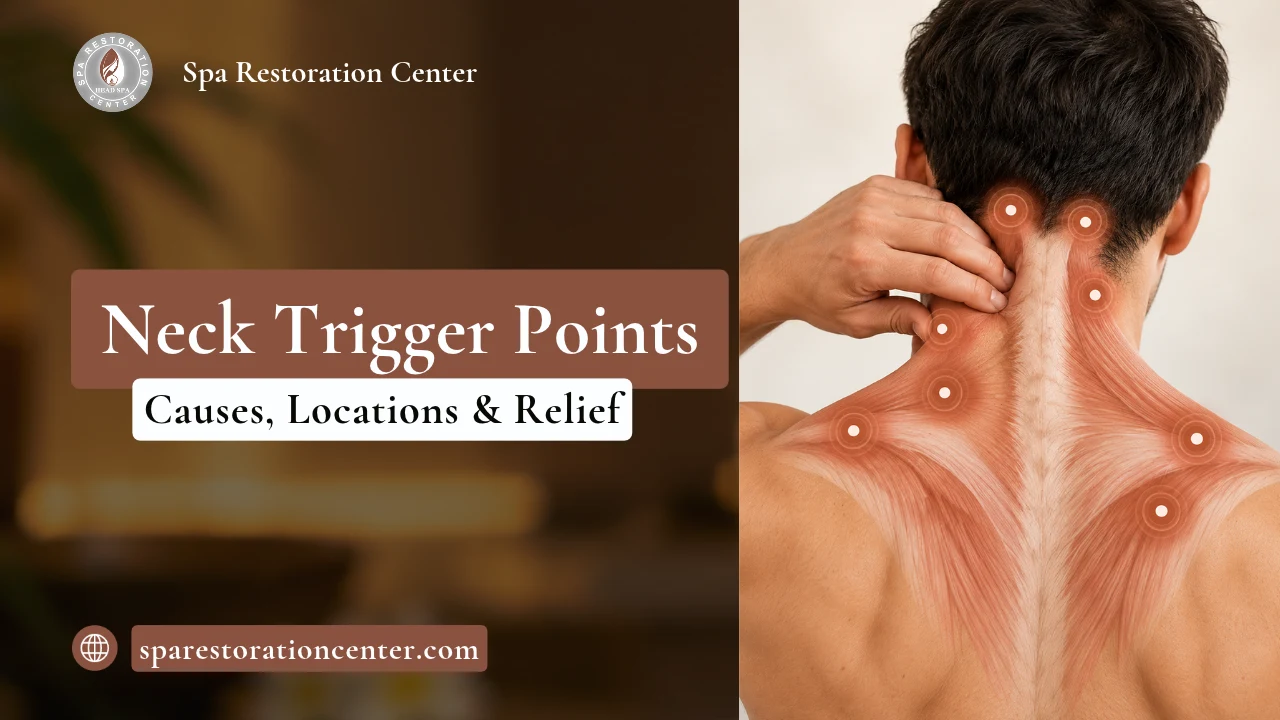
Some neck pain doesn’t stay in the neck. You feel a dull ache behind one eye, or a tight band near your temple, and the real cause turns out to be a tender spot lower down. That’s how neck trigger points tend to behave. Basically, each is a sore little patch in a muscle that likes to pass its pain along to somewhere else.
This guide covers where they hide in your neck and how they feel when you find one. It also covers what gets them to relax, and when a doctor should see you before any massage therapist does.
What Are Neck Trigger Points?
A trigger point is a spot in a muscle that’s tighter and touchier than the muscle around it. Cleveland Clinic says it may feel like a small bump or a knot. It can ache even when you’re not poking at it. If a doctor or therapist is checking for one, they’ll slide their fingers across the muscle until they hit a tight cord, something like a guitar string sitting under the skin.

Pressing one can cause pain right at that spot. Or the pain can pop up close by instead, and Cleveland Clinic calls that referred pain. So you might feel two things at once. One hurts under your finger. The other shows up a few inches away, and that’s the one that confuses people.
Where Are Common Neck Trigger Points Located?
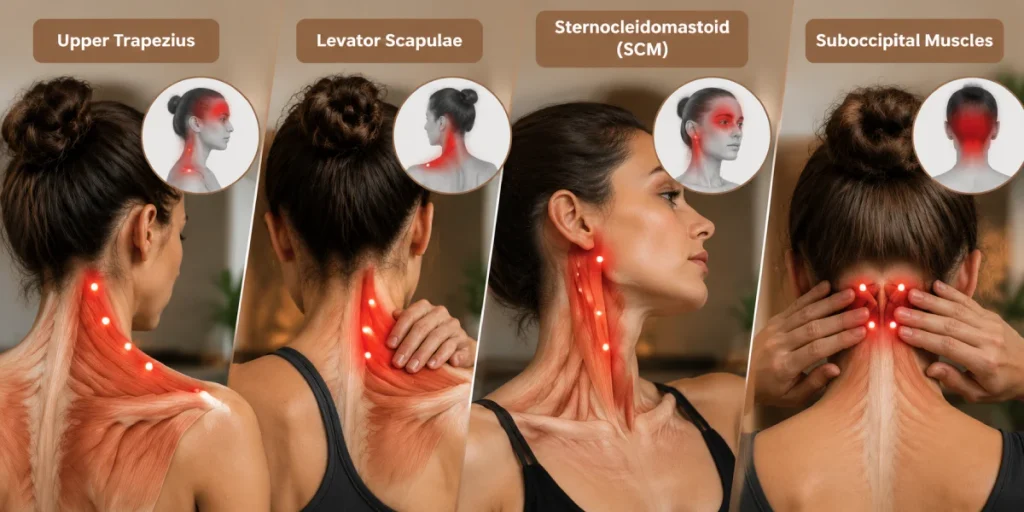
Pretty much any muscle can get them. In the neck, though, the same few muscles keep showing up in medical write-ups, and each one has a favorite spot plus a typical place it sends pain. These are the four worth knowing, plus a couple of extras.
Upper Trapezius
This one’s the big muscle that runs from the back of your neck to the top of each shoulder. It’s what bunches up when you hunch over the steering wheel in traffic. FPnotebook, a clinical reference written by a physician, says this is the muscle that’s involved most. When it has trigger points, the pain can travel up the side of your neck and land near your temple.
Levator Scapulae
Levator scapulae is a mouthful, but the muscle itself is simple. It’s a strap that goes from the side of your neck to the top inner corner of your shoulder blade. Per Physiopedia, a tight one gives you a deep ache at the top of the shoulder blade or in the neck, and a headache can tag along. You might find it hard to tip your ear toward the other shoulder. Physiopedia ties tightness here to forward head posture, which is a fancy name for craning your chin toward your laptop all day.
Sternocleidomastoid (SCM)
You can find your SCM by turning your head to one side. That cord popping out, from just behind your ear down to your collarbone, is the one. Back in 2004, a case study in the Journal of the Canadian Chiropractic Association described SCM trigger points causing pain at the forehead and around the eye. Some people feel it inside or behind the ear instead. FPnotebook lists ear pain as well, and says a few people get dizzy or teary-eyed.
Suboccipital Muscles
Tucked right under the base of your skull sit four small muscles called the suboccipitals. Researchers writing in Headache in 2006 checked 20 people who had chronic tension-type headaches. Thirteen had active trigger points here. Their heads also sat farther forward than those of people without headaches. Keep in mind it was a pilot study. It found a connection, but it didn’t prove cause.
Other Commonly Discussed Neck and Upper-Shoulder Areas
A few more spots come up in clinical references. There’s the splenius capitis at the back of your neck, which FPnotebook says can cause pain behind the eye or at the top of the head. Then there are the thin muscles along both sides of your neck bones, which can push pain into the back of your head.
What Does a Neck Trigger Point Feel Like?
The 2004 case study calls the referred pain deep and dull. It isn’t sharp. Your neck may feel stiff too. Some people can turn one way just fine, but not the other.
That said, trigger points aren’t behind every sore neck. A worn joint or a disc problem can hurt too, and that’s something for a doctor, not a massage therapist.
Can Neck Trigger Points Cause Referred Pain?
Yes. It’s the main thing that makes them different from an ordinary sore muscle. With referred pain, you feel it somewhere other than where the trigger point actually is. Going by the sources we’ve mentioned, the upper trapezius may push pain toward your temple, while the SCM may send it to your forehead or ear. The levator scapulae tends to send it along the shoulder blade.
These patterns are useful background, but they aren’t a self-diagnosis tool. Temple headaches have lots of possible causes, from eye strain to skipped meals. If yours are new, or they feel different from your usual ones, see a doctor before deciding it’s your trapezius.
How Are Neck Trigger Points Released?
Most of the time, neck trigger point release comes down to pressing on the sore spot and staying there until the muscle softens. Cleveland Clinic’s chiropractor says you can hold for up to 90 seconds, using as much pressure as feels okay. During a massage, your therapist will usually loosen the area around the knot before going after it directly. If you want to understand how targeted pressure differs from broader muscle work, read our guide to trigger point massage vs deep tissue.
Pressing on it isn’t your only tool, though. For people asking how to relieve trigger points in neck muscles, a sports medicine doctor at Cleveland Clinic recommends stretching, plus some heat from a heating pad or a warm bath. Standing up from your desk now and then makes a difference too. If the pain won’t go away, Cleveland Clinic says a doctor may suggest physical therapy, dry needling or trigger point injections.
Skip the DIY approach if an injury started the pain, if it’s getting worse, or if you’ve got numbness or tingling. Those need a doctor first.
Self-Massage for Neck Trigger Points
A little self massage on neck trigger points is fine for everyday tightness, as long as you stay in the safer areas. If you’re learning how to release trigger points in neck muscles at home, start with these spots:
- The top of the shoulders
- Between your shoulder blades
- Back of the neck, off to the side of the spine
Start on top of your shoulder. Find the sore spot, push in with a fingertip and hold. Stop at around 90 seconds, or sooner if it’s too much. The space between your shoulder blades is awkward to reach on your own, and Spine-health‘s fix is a racquetball. Pin it between your back and a wall, lean into it and roll it around for about two minutes.

Leave the front and sides of your neck alone. That’s where major blood vessels and nerves run, so deep pressure there is a job for a trained professional. Massage guns should stay off bony spots like your spine, according to Cleveland Clinic. And if you get a sharp pinch or a tingle, quit right there. That isn’t how a tight muscle feels when it lets go.
Neck Trigger Point Massage: What to Expect
At Spa Restoration Center, we talk with you before we start. We’ll ask where it hurts and how you’d like to feel when you leave. That tells your therapist which muscles need the most time. A shoulder and neck massage can also be an option when you want focused attention on tension in these areas.
How hard we press is your choice. Pick light, moderate or deep pressure before the session. Your therapist will warm up your neck and shoulders, then slow way down and lean in when they find a knot. Getting to be too much? Say so, and they’ll lighten up.
Don’t expect the whole hour to be trigger point work. It tends to be one part of a neck and shoulder massage. If you’re looking for more targeted neck and shoulder pain relief, your therapist can focus on the areas that feel tight or uncomfortable. If you’d like extra warmth to loosen things up first, hot stone therapy is available as an add-on.
If you’re deciding between firm pressure and a gentler experience, read our guide to deep tissue vs relaxation massage to compare the two approaches.
For the most part, these are two names for the same thing. Cleveland Clinic says the medical term for a muscle knot is a myofascial trigger point. “Knot” is the word most people use, while “trigger point” is what you’ll hear from therapists and in medical writing.
The one difference worth knowing is referred pain. People usually call any tight lump a knot. ‘Trigger point’ puts more weight on the fact that it can cause pain somewhere else when pressed. If you’re comparing massage techniques, read more about trigger point massage vs deep tissue to understand how they differ.
When Neck Pain Should Be Evaluated by a Healthcare Professional
Massage can help tight muscles, but it can’t tell you why your neck hurts. Neck symptoms can come from causes that have nothing to do with trigger points. According to Mayo Clinic, see a doctor if your neck pain comes with any of these:
- A recent fall, crash or other injury
- Weakness in an arm or leg
- Numbness or tingling
- Pain spreading down your arms or legs
- A high fever
Mayo Clinic says some of these, like severe neck pain after an injury or with a high fever, need emergency care. You should also see a doctor if the pain gets worse even with self-care, or hasn’t improved after several weeks.
Frequently Asked Questions
How Long Does It Take to Release a Neck Trigger Point?
A single hold can last up to about 90 seconds, according to Cleveland Clinic. Some knots loosen up in a single visit. Some need two or three sessions. And if nothing’s changed after several tries, get a doctor or physical therapist involved.
Can Trigger Points in the Neck Cause Headaches?
They can be part of the picture. Trigger points in the SCM and in the small muscles under your skull are linked with head pain in medical references. Headaches have plenty of other causes too, so new or severe ones need a doctor.
Is It Safe to Massage the Front of My Neck?
Not on your own. Major blood vessels and nerves run along the front and sides of your neck. Stick to the top of your shoulders and the back of your neck, and leave the SCM to a trained therapist.
Can Bad Posture Cause Trigger Points in the Neck?
Posture may play a role. The 2006 suboccipital study found more forward head posture in people with chronic tension headaches. Taking breaks from your screen and keeping it at eye level can take some strain off your neck.
Ready to work out that neck tension? Visit Spa Restoration Center to book a massage and choose the pressure that feels right for you.
Final Thoughts
Here’s the quick recap. Neck trigger points are tender spots inside muscles like your upper trapezius and SCM. Pressing one can hurt right where your finger is. It can also make your temple or shoulder blade ache. Steady pressure loosens them up, and stretching with a warm compress helps as well. At home, keep to the tops of your shoulders and the back of your neck. If you’ve got numbness, weakness or a fever, call your doctor before anyone else. Whenever you want an expert pair of hands, our Arlington team is here.