Got a spot under your shoulder blade that makes you yelp when a friend pokes it? That’s usually a trigger point. Trigger point massage goes after that exact spot. Your therapist finds the knot, leans in with a thumb and stays put until the muscle gives a little. It’s slower than a normal massage, and yes, it can sting for a few seconds. Below, you’ll find what trigger points are and where they tend to hide.
We also get into the session itself, plus the point where a doctor makes more sense than a massage table.
What Is Trigger Point Massage?
So, what is a trigger point massage, in plain terms? Think of it as massage with a target. Rather than sweeping across your back, your therapist parks a thumb on one sore spot and presses. Chad Adams, a chiropractor quoted by Cleveland Clinic, calls it a form of myofascial release. Basically, the pressure goes right on the point to calm the tension and the pain.
The twist is that these spots don’t always hurt where they are. Press one near your shoulder blade, and you might feel it in your neck. Doctors call that referred pain. It’s also why people end up typing “massage triggerpoint” into Google when an ache won’t go away and they can’t tell where it starts. Some places call the same thing trigger point therapy. Same idea, different label.
What Is a Trigger Point?
Here’s a simple trigger point definition: a small, tight spot in a muscle that’s sorer than everything around it. Medical sources use pretty much the same definition of a trigger point. Cleveland Clinic’s version is “small bumps, nodules or knots.” When a provider checks for muscle trigger points, they run their fingers across the muscle looking for a taut band. It feels a bit like a guitar string under the skin.
Most of the time, the muscle has just been overworked. WebMD’s list of causes includes repeated strain from your job or the gym, slouching, and staying in one position for hours. Bad sleep and stress don’t help either.
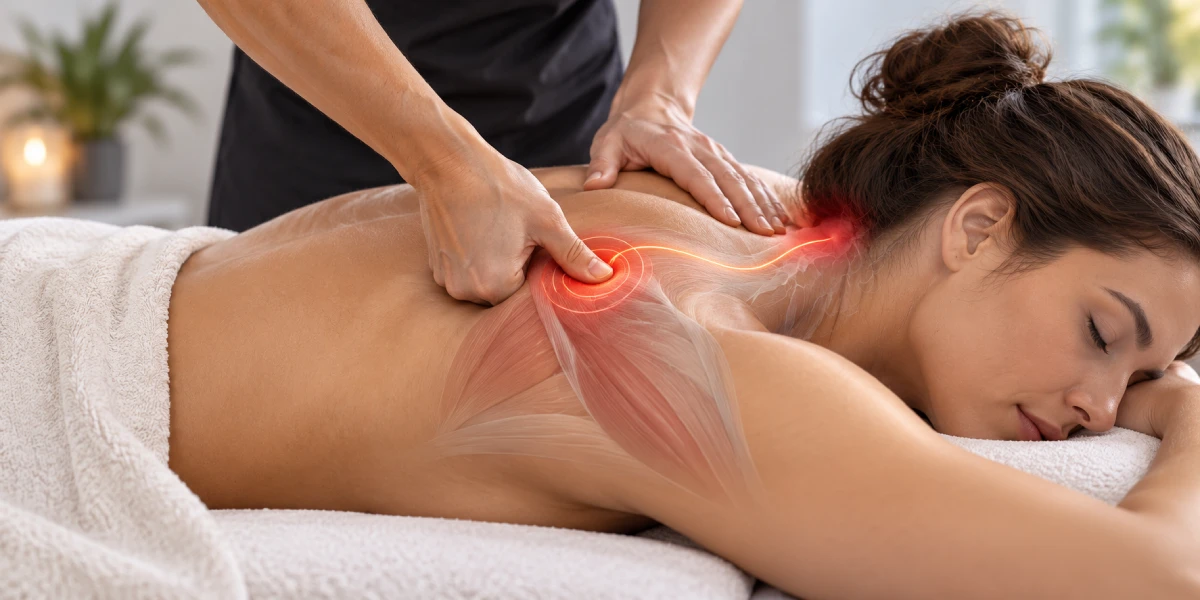
Not every trigger point hurts all the time. WebMD splits them into two kinds. Active ones ache even when you leave them alone. Latent ones keep quiet until somebody presses on them. Both can throw pain somewhere else, though. So the real trigger point meaning has less to do with the lump and more to do with how much it hurts, and where that hurt ends up.
How Does Trigger Point Massage Work?
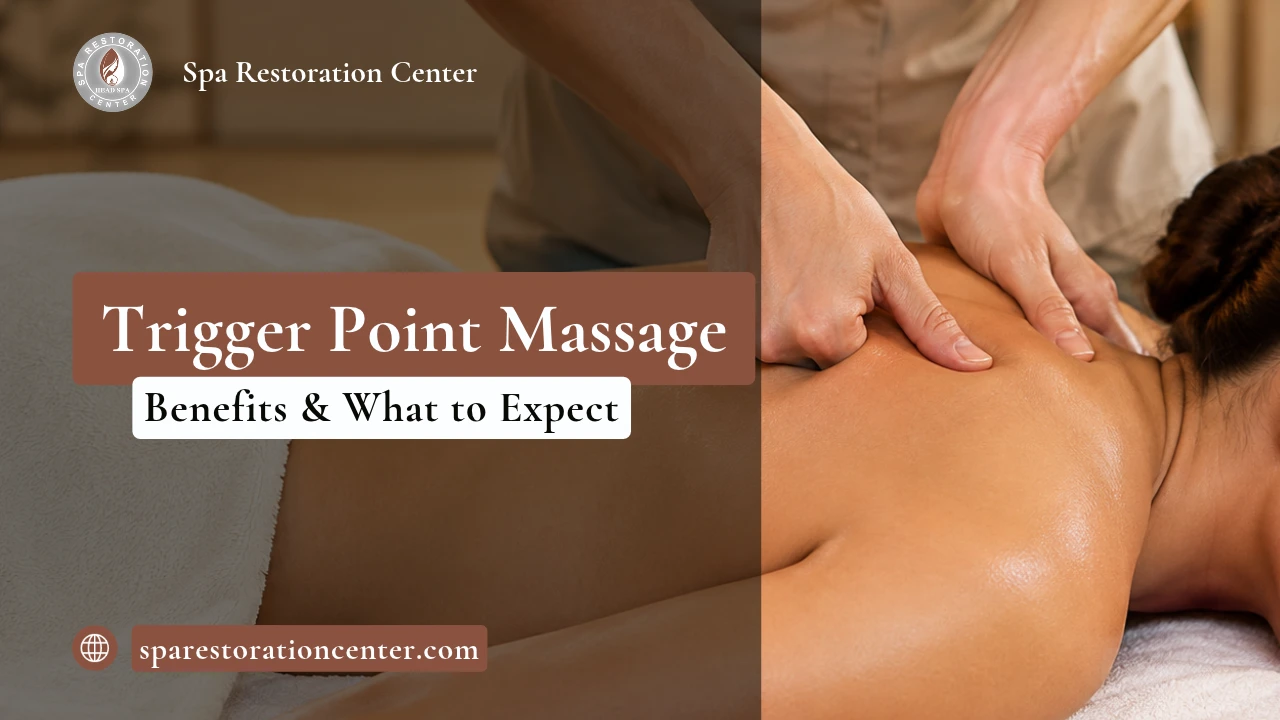
First, your therapist has to find it. They’ll ask you to point to the sore area, then slide their fingers along the muscle until you flinch or they hit a tight cord. That’s the spot. They press in and hold.
That hold is the core of trigger point massage therapy. Cleveland Clinic says it can last up to 90 seconds. Hinge Health gives a range of 30 to 90 seconds, with you breathing slow and deep the whole time, followed by long, light strokes. The goal is pretty simple. Get that little patch of muscle to quit pulling.
It’s worth being honest about the science. Hinge Health admits experts still argue about what trigger points even are, and why they form. People do report feeling better after massage. But nobody has pinned down exactly why it works.
What Does Trigger Point Massage Feel Like?
Mostly a “good hurt.” You’ll feel a deep, dull ache right where the thumb is. Every now and then the ache jumps to a different spot, which can catch you off guard the first time.
According to Cleveland Clinic, a bit of discomfort is fine. Intense pain isn’t. Hinge Health’s rule is that the pressure should stay tolerable. Catch yourself holding your breath, or curling your toes? Speak up. They’ll ease off.
Afterward, the spot might feel a little tender for a day. Hinge Health says that’s normal if it improves within about 24 hours.
Where Are Common Trigger Points Found?
Trigger points can show up in pretty much any muscle. Still, a few trigger point areas come up again and again, and most of them are muscles that hold you up or repeat the same motion all day. Here are the body trigger points people bring up most:
- Neck
- Shoulders
- Upper back
- Lower back
- Hips
- Legs
Both WebMD and Hinge Health mention the neck and shoulders. These areas can develop trigger points in the neck that cause discomfort beyond the original spot. Hinge Health also points to the lower back and hips.
For legs, WebMD calls out the calves and hamstrings, mostly in runners and people who play sports. Work at a desk? Check the tops of your shoulders first.
Trigger Point Massage vs. Massage for General Muscle Tension
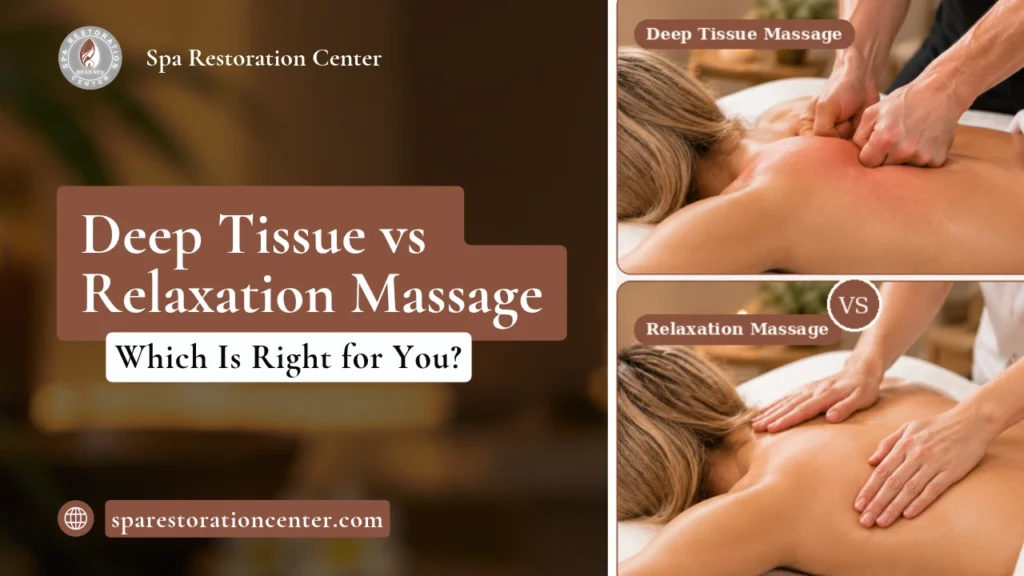
A regular muscle tension massage moves around a lot. Your therapist works through your whole back or both legs with flowing strokes, loosening everything a little. This broader approach is closer to relaxation massage, while trigger point work zooms in on specific sore spots.
Your therapist might spend several minutes on a spot the size of a coin.
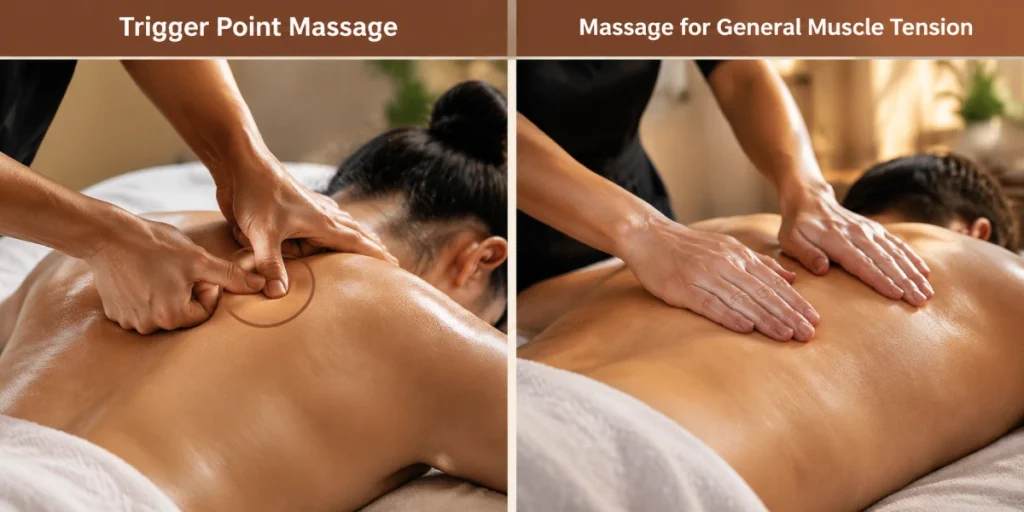
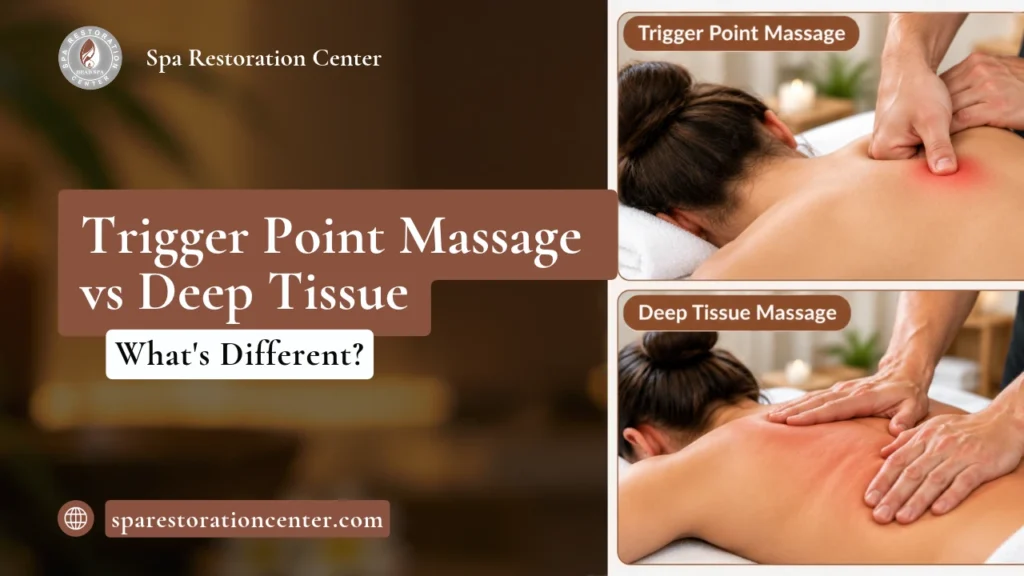
Neither is better. If your whole back feels tight, broad work makes sense. If one spot keeps nagging you, a focused muscle pain massage on that point is the more direct approach. The difference between trigger point massage and deep tissue massage comes down to how broadly or specifically the therapist works on the muscles.
Plenty of sessions mix the two, using general strokes to warm things up before working on the stubborn trigger spots.
Trigger Point Release Techniques a Therapist May Use
There’s no single method, and every therapist has their own way of working. Most trigger point release techniques come back to steady, focused pressure, though. On the table, it might go something like this.
Trigger point release usually begins with a thumb or fingertip pressing straight down and not moving. After that, some therapists run slow strokes along the muscle to settle it. Others gently stretch the muscle once the pressure comes off.
Your therapist may also use broader myofascial release trigger points work, which targets the fascia, the thin layer of tissue that wraps around each muscle. Cleveland Clinic counts this technique as a type of myofascial release, and you’ll sometimes see the combination called trigger point myofascial therapy.
What about trigger point self massage at home? Cleveland Clinic says you can press a tender spot with your fingers for up to 90 seconds, or use a massage ball or foam roller for bigger areas. Go easy, though. Feel a sharp pinch, or tingling? Stop. And keep your hands off the front of your neck.
What Happens During a Trigger Point Massage Session?
At Spa Restoration Center, the first few minutes are just talking. Your therapist will want to know where it’s sore and how firm you like it. They’ll also ask how you want to feel when you walk out. Then you pick light, moderate or deep pressure. If one area turns out to be extra touchy, they’ll back off there.
The first part of the massage is slower and broader, just to warm the muscles up. Once things soften a bit, your therapist goes looking for the tender spots and holds steady pressure on the knots. You’ll be checked on as they go. Expect them to ask how it feels, especially on the sore spots.
There’s no separate trigger point therapy massage on our menu. Focused work on knots happens inside a regular massage, like our Body Restoration Massage (60 or 90 minutes) or our neck and shoulder massage. If you only want your back worked on, our 30-minute back massage is another option. Want heat or suction too? Hot stone and cupping are both available as add-ons.
When Should You Talk to a Healthcare Professional Instead?
Massage for muscle knots can loosen things up. It can’t tell you why you hurt, though. According to WebMD, see a doctor if you notice any of these:
- Pain that won’t go away or keeps getting worse
- Pain that keeps you up at night
- A sore red spot that feels hot
- Pus, blood or any other drainage
Had surgery or an injury recently? Get your doctor’s okay first. The same goes for blood clots, osteoporosis and blood thinners. Hinge Health lists all of these as reasons to be careful with firm, focused pressure. And for stubborn, long-term pain, a doctor may suggest trigger point treatment like physical therapy, dry needling or injections. Those aren’t things a spa can offer.
Frequently Asked Questions
What Are Trigger Points in Massage?
They’re the tender spots your therapist works on directly. Massage therapists use the term trigger points for tight little patches that hurt when pressed, and that can send pain somewhere else.
What Does a Trigger Point Feel Like?
Usually a small, sore lump or tight band in the muscle. WebMD says it can feel like a pea, a small egg or a ball under the skin. Pressing it hurts more than the muscle around it.
What Does a Trigger Point Look Like?
Most of the time, you can’t see one at all. They’re buried inside the muscle, WebMD says. Your fingers will find one way before your eyes do.
What Happens When a Trigger Point Is Released?
Usually the spot just gets less sore, and the muscle around it loosens up some. You might turn your head a little farther, say, or reach up without that pull. Or you might feel a little sore for a day before it settles.
Can Massage Release Trigger Points?
It can help. Cleveland Clinic lists this kind of pressure as one way to ease knots in small areas. Massage therapy for muscle knots won’t fix every case, though, and Hinge Health notes the relief tends to be short-term.
How Many Sessions Will I Need?
There’s no set number. Some knots ease after one visit, and stubborn ones can take a few. Hinge Health suggests rethinking the plan if you’ve had two or three sessions and nothing has changed.
Is Trigger Point Massage Painful?
A few seconds of “ouch” can happen. Real pain shouldn’t. If it’s too much, say so, and your therapist will lighten up.
Ready to work out that stubborn knot? Visit Spa Restoration Center to book a massage and choose the pressure that feels right for you.
Final Thoughts
Trigger point massage is all about focus. Find the tender knot, press, hold, wait for it to let go. That’s the whole method. Strong is okay. Pain that makes you clench up is not. Most trigger points live in the neck, shoulders and back, but they can pop up nearly anywhere. A little sore tomorrow? Normal. Pain that won’t settle needs a doctor. If there’s a spot that keeps bugging you, come see our Arlington team, and we’ll find it and work on it at a pressure that suits you.